Showing posts with label english writers. Show all posts

Monday, May 6, 2013

Book Review: Sweet Tooth by Ian McEwan


I have to begin this review with an admission: I have never liked “Atonement”, the book that was a great success for the author, and which became a successful movie as well. I found it kind of boring and too long. On the other hand I did like his much shorter “On Chesil Beach”. That one was a pleasure to read, mainly because it told a story in a masterful way and in the right amount of words.

“Sweet Tooth” I have loved as well, even though at the beginning I felt reluctant to dive into its world. I guess that had to do with my distrust of the big newspaper critics who are willing to hail every book as a masterpiece once its author is of McEwan’s fame and caliber. I’m so glad that I was proven wrong, and that I did get to read this novel. It is a masterpiece. I’m not saying that it’s the best fiction book I’ve ever read, but it is one of the best I have read this year.

This is a story of lovers and spies, and of writers and politicians, in a highly charged era of the European history. We meet the heroes in London in the early seventies. The cold war is going strong, the people feel insecure, and the propaganda, or mind games are at their peak. It is under these circumstances that a young and seemingly brilliant woman is recruited by the British secret service. At first she has nothing much to do, she’s a paper pusher, but one day her luck will change and she’ll be given a mission, to help an author promote her country’s interests.

What ensues is an adventure, with not too much action, but with a lot of ups and downs. As the reader will soon come to understand most of the actors in this drama are more or less sad, and they are mostly ignorant: “Everyone knew as much as they needed to know to be happy,” we read, but yet that happiness eluded them.

If it wasn’t for the author’s beautiful prose and the final twist that takes the reader by surprise this would be a brilliant but sad story, as we follow the footsteps of two people who are doomed to fail. However, things are not exactly the way they seem, and as McEwan seems to suggest, even if the whole world comes tumbling down, there’s still hope to be found.

I believe that anyone out there that likes literary fiction of the highest quality should read this novel, as it has a lot to offer: raw emotions, a great story, a beautiful background, and exquisite writing.

Tuesday, February 21, 2012

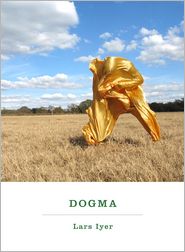
Book Review: Dogma by Lars Iyer


Dogma, unlike the author’s previous novel, Spurious, has received mixed reviews. The latter was welcomed as a masterpiece, but when it came to the former the critics were not that enthusiastic. Now that I have read the novel I can say that I really wonder why? Why did they not like it as much as Spurious? For me this a great novel, as it combines humor, irony, philosophical thought, amazing discussions-monologues and a peripatetic mood.
     Even though Dogma is the second novel in a not so closely knit trilogy, which will come to its end next year with the Exodus, one can easily read it as a standalone volume.
     The main protagonists in this story are two friends: W, who’s a Catholic Jew atheist and Lars, who’s more or less, or rather less than more, Hindu. The first thinks too much and philosophizes a lot about the end of days, while at the same time he’s preparing two projects on capitalism and religion (“Capitalism is the evil twin of true religion,” he claims), while the second just lives, or maybe I should say survives, in the shadow of his friend. I think that this is one of the oddest couple of friends that I’ve ever encountered in world literature. They are so different from each other that the only thing that seems to keep them close together is the simple fact that no one else could ever put up with them. W on the one hand, never stops thinking and talking, every now and then he points his poisonous words towards his friend, who’s a non-thinker, he often enough throws one-liners in their conversations while trying to make a point, he gets angry and revolts constantly, at least in his head, and he makes new decisions all the time; decisions which sometimes he sticks to, but most times he doesn’t; to put it simply he’s not only a man of words, but also one of action. As for Lars, who’s the narrator, he simply seems to be nothing more than a receptacle. He just listens to his friend, he puts up with his whims, he follows him in his varied adventures, he learns from him, and every now and then, when he absolutely has to, he opens his mouth to say a few words to appease the spirits and bring serenity to W’s soul. Most of the times all he has to do to achieve that is quote the Vedas or tell him stories from the Hindu mythology.
     Their dialogues, or rather W’s monologues, are simply a joy to behold. And, as one would expect, quotation time it is: “You should never learn from your mistakes”; “We must read if we want to live”; “We’re not capable of god”; “Philosophy’s like an unrequited love affair”; “Always claim the ideas of others as your own”; “The Dogma must always be drunk”; “Only the hopeless can truly understand the everyday.”
     W looks and sounds like a prophet of the end. He expects catastrophe to hit the earth any time now; and he feels that more strongly than ever in America, where the ignorant natives apart from having no Plymouth Gin for sale, they have also “made a Disneyland of Armageddon.”
     “It’s time to die,” he says at the end, “but death does not come.” Thankfully, I should add; because if it did then we’d miss the opportunity to enjoy the third part of his unique mental and physical escapades.
     Highly recommended to everyone out there who loves good literary fiction.

Wednesday, March 30, 2011

D.H. Lawrence - England, My England

He was working on the edge of the common, beyond the small brook that ran in the dip at the bottom of the garden, carrying the garden path in continuation from the plank bridge on to the common. He had cut the rough turf and bracken, leaving the grey, dryish soil bare. But he was worried because he could not get the path straight, there was a pleat between his brows. He had set up his sticks, and taken the sights between the big pine trees, but for some reason everything seemed wrong. He looked again, straining his keen blue eyes, that had a touch of the Viking in them, through the shadowy pine trees as through a doorway, at the green-grassed garden-path rising from the shadow of alders by the log bridge up to the sunlit flowers. Tall white and purple columbines, and the butt-end of the old Hampshire cottage that crouched near the earth amid flowers, blossoming in the bit of shaggy wildness round about.

Continue at the source: Literature org


Image taken from here


Book Choice: Sons and Lovers: (RED edition) (Penguin Classics)

Tuesday, February 3, 2009

Sir Walter Scott - My Aunt Margaret's Mirror

My Aunt Margaret was one of that respected sisterhood upon whom devolve all the trouble and solicitude incidental to the possession of children, excepting only that which attends their entrance into the world. We were a large family, of very different dispositions and constitutions. Some were dull and peevish--they were sent to Aunt Margaret to be amused; some were rude, romping, and boisterous--they were sent to Aunt Margaret to be kept quiet, or rather that their noise might be removed out of hearing; those who were indisposed were sent with the prospect of being nursed; those who were stubborn, with the hope of their being subdued by the kindness of Aunt Margaret's discipline;--in short, she had all the various duties of a mother, without the credit and dignity of the maternal character. The busy scene of her various cares is now over. Of the invalids and the robust, the kind and the rough, the peevish and pleased children, who thronged her little parlour from morning to night, not one now remains alive but myself, who, afflicted by early infirmity, was one of the most delicate of her nurslings, yet, nevertheless, have outlived them all.
It is still my custom, and shall be so while I have the use of my limbs, to visit my respected relation at least three times a week. Her abode is about half a mile from the suburbs of the town in which I reside, and is accessible, not only by the highroad, from which it stands at some distance, but by means of a greensward footpath leading through some pretty meadows. I have so little left to torment me in life, that it is one of my greatest vexations to know that several of these sequestered fields have been devoted as sites for building. In that which is nearest the town, wheelbarrows have been at work for several weeks in such numbers, that, I verily believe, its whole surface, to the depth of at least eighteen inches, was mounted in these monotrochs at the same moment, and in the act of being transported from one place to another. Huge triangular piles of planks are also reared in different parts of the devoted messuage; and a little group of trees that still grace the eastern end, which rises in a gentle ascent, have just received warning to quit, expressed by a daub of white paint, and are to give place to a curious grove of chimneys.

Continue at the source
Image taken from here


Book Choice: Ivanhoe (Penguin Classics)

Sunday, January 18, 2009

Elizabeth Gaskell - The Manchester Marriage

Mr and Mrs Openshaw came from Manchester to settle in London. He had been, what is called in Lancashire, a salesman for a large manufacturing firm, who were extending their business, and opening a warehouse in the city; where Mr Openshaw was now to superintend their affairs. He rather enjoyed the change; having a kind of curiosity about London, which he had never yet been able to gratify in his brief visits to the metropolis. At the same time, he had an odd, shrewd contempt for the inhabitants, whom he always pictured to himself as fine, lazy people, caring nothing but for fashion and aristocracy, and lounging away their days in Bond Street, and such places; ruining good English, and ready in their turn to despise him as a provincial. The hours that the men of business kept in the city scandalized him too, accustomed as he was to the early dinners of Manchester folk and the consequently far longer evenings. Still, he was pleased to go to London, though he would not for the world have confessed it, even to himself, and always spoke of the step to his friends as one demanded of him by the interests of his employers, and sweetened to him by a considerable increase of salary. This, indeed, was so liberal that he might have been justified in taking a much larger house than the one he did, had he not thought himself bound to set an example to Londoners of how little a Manchester man of business cared for show. Inside, however, he furnished it with an unusual degree of comfort, and, in the winter-time, he insisted on keeping up as large fires as the grates would allow, in every room where the temperature was in the least chilly. Moreover, his northern sense of hospitality was such that, if he were at home, he could hardly suffer a visitor to leave the house without forcing meat and drink upon him. Every servant in the house was well warmed, well fed, and kindly treated; for their master scorned all petty saving in aught that conduced to comfort; while he amused himself by following out all his accustomed habits and individual ways, in defiance of what any of his new neighbours might think.
His wife was a pretty, gentle woman, of suitable age and character. He was forty-two, she thirty-five. He was loud and decided; she soft and yielding. They had two children; or rather, I should say, she had two; for the elder, a girl of eleven, was Mrs Openshaw's child by Frank Wilson, her first husband. The younger was a little boy, Edwin, who could just prattle, and to whom his father delighted to speak in the broadest and most unintelligible Lancashire dialect, in order to keep up what he called the true Saxon accent.

Continue at the source
Image taken from here

Book Choice: The Cranford Chronicles: Cranford / Mr. Harrison's Confessions / My Lady Ludlow