Showing posts with label italian writers. Show all posts
Monday, July 2, 2012
Book Review: Me, You by Erri De Luca
Me, You is one of those beautifully written and tender books that talk about the past; a past during which everything seemed to be much simpler than today and where people were more friendly and open-hearted, and the summers smelt of play and love.
It is during a summer that a city boy arrives at an island, where all of a sudden he feels a sense of joy and unlimited freedom overwhelming his youthful being. He was, as he puts it, a city kid, but during the summer he used to be transformed into a savage.
However that’s not exactly true; he did not transform into someone else when he was there, he just became his real self; a self that enjoyed going fishing with his uncle and mysterious Nicola, who fought during WWII in Sarajevo, and who taught him the ways of the sea without ever telling me what to do, and who also told him that from the sea you get what it gives and not what you want. He also liked wandering around the island and meeting people, following his cousin Daniel to the beach and participating in his parties and, every now and then, being naughty.
The summers always made him feel rich, but this one was bound to prove his best ever, since during it he would meet a girl, a bit older than him, that would fill his heart with joy and make him feel for the first time how it is for someone to be in love: “Within Caia was a revelation that could be reached by love”.
Caia was not an ordinary young woman. Most of the time she looked deeply lost in thought, every now and then she seemed to bathe in melancholy, but she always had an aura of wisdom surrounding her being. It was as if life has taken everything away from her and gave her in exchange an almost unnatural, for her age, maturity. Her eyes looked dark, kind of haunted, as if they’ve seen everything there was to see. And most probably it was that darkness in her gaze that he found her most attractive, almost mesmerizing feature. “In her presence my breathing was even; away from her it was agitated.”
What was the best thing that happened during their time together? Sitting one night at an open air cinema, watching For Whom the Bell Tolls, and him, hugging her from behind and smelling her hair.
Well, she couldn’t stay there forever and neither could he. She left first and that broke his heart, even though another girl, of his own age this time, materialized almost out of thin air to claim a piece of what was left inside of him: “She was inviting me to an age that have disappeared from my body and mind,” he says, and he surely couldn’t go back there. Not yet, anyway.
This is a beautiful story about summer, love and an age of innocence, for the magical moments of life which become scarcer as time goes by, for times long gone but never forgotten; a bittersweet novella that somehow manages, in a very direct way, to transmit its deeply humane messages to the reader.
Labels:
book review,
Erri De Luca,
italian literature,
italian writers,
Me You,
novel,
Sea of Love,
summary,
synopsis
Wednesday, February 15, 2012
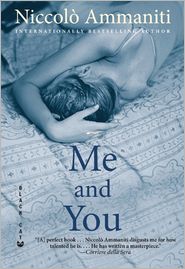
Book Review: Me and You by Niccolo Ammaniti
Me and You is one of those books that somehow manage, in an almost magical way, to steal a reader’s heart; and that not so much because of their myth, but because of the prose; a prose that sounds tender, almost nostalgic, and which every now and then seems to converse with the silence and the psyches. This is the story of Lorenzo, a fourteen year old boy that doesn’t seem to do well in the world he lives in, but who also tries hard not to show it. And that, because of his mother, whom he deeply loves, and whose aura for some reason reminds him of Morocco. “Life is sad without a sense of humor,” the author says, and that’s exactly the element that’s missing from the boy’s life. Whatever he does he can never feel glad, not even a little bit happy. Apart from his mom the only other person he seems to get on well with is himself. His parents cannot really understand him and feel sorry for him, and that’s why he decides to take a trip to the mountains with some of the popular kids in his class. But of course that trip will never come to be, because he just made it up. His plan is simple: while his parents will feel happy thinking that he’s at last at some faraway place and having fun with some other people, he’ll be hiding in a long forgotten storeroom in the basement of their building. At the beginning everything goes according to plan: He stocks his humble abode with all the supplies he’ll need for his week-long stay and then spends some quality time with himself, playing video games, watching TV and thinking deeply about his life; “Why did I have to be just like the others?” “On my own I was happy, with the others I always had to pretend.” Now, hidden as he is in his beloved basement and isolated from the whole world, yes, he does feel a little bit happy. Life, however, is not about to leave him in peace for long. So, in comes Olivia, his half-sister who has serious drug abuse issues, and who from one moment to the next smashes his fragile, but seemingly secure, world to pieces. Thus the free man becomes the slave; a slave to her needs; her personal slave. Someone has to help her fulfill those needs, and if not Lorenzo, then who? Ammaniti seems to closely observe and analyze the dynamics that develop between these two young souls; dynamics that somehow seem to presage a complete catastrophe. As it seems the one simply cannot stand the other. However, like it or not, they need each other, because if their secrets come to light they both have a lot to lose. So they form an alliance, one that will help them survive their troubles, make them realize some things, and give them the chance to see their selves as they truly are. The fall for the two of them doesn’t seem to be far, but neither is the recovery. Just as Olivia writes to her father: “I have to learn not to hate you,” Lorenzo needs to learn how not to hate living with the other people. A well-written novella that can easily be read in a single sitting, and which has a lot to say to the observant reader. Highly recommended.
Labels:
book review,
italian literature,
italian writers,
Me and You,
Niccolo Ammaniti,
novel,
summary,
synopsis
Tuesday, November 15, 2011
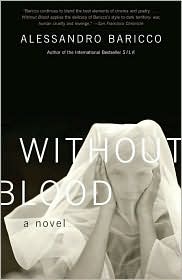
Book Review: Without Blood by Alessandro Baricco
Baricco has a unique gift with words and an ability to enchant the readers with his stories. Every time I read one of his books I’m met with a new surprise, and it’s always a pleasant one.
The main protagonist in Without Blood is Nina. At the beginning of the story we meet her while hiding with her family in an old house in the countryside, in an anonymous country, during an unnamed civil war, which however reminds us of the Spanish.
Nina’s father, Manuel Roca, is not on the winning side, and he seems to have a lot of enemies, so they have to live in hiding to stay alive. But no matter how much they want to escape the past, one day it will catch up with them and the results will be devastating. Their enemies, headed by a man called Salinas, will track them down and a battle will ensue during which Manuel and his son will be killed. Little Nina however who during all this hustle was hidden in the basement will survive. And then…
And then the years swiftly go by, and there comes a time that Nina sets out to take her revenge. She’s afraid of nothing and of no one and she’s determined to spare no effort to reach her goal. And thus yesterday’s hunters become today’s prey.
Of course, as one would expect, in a Baricco story nothing is exactly the way it looks; the author seems to suggest that every coin has two different sides; but of course that doesn’t mean that the one voids the other. At the end of the day what counts the most are the facts; it is them that write the history, it is them that engrave the souls. It is them thus that engraved Nina’s soul, but they were not enough to completely rob her from her humanity, because even though she’s out for revenge she’s not willing to inflict more pain than the pain inflicted on her, while at sometime she reaches a certain point where she can stare with a clear eye on her enemies’ truths. Besides, as we read: “You cannot dream of a better world and think that it will be delivered just because you ask for it.” The world is what it is, the author seems to say, the past cannot change, but it’s nevertheless worth the trouble to fight to make today and tomorrow a little bit better, a bit more humane.
This is a well-written novella about the recurrent mistakes of men and their eternal passions.
Subscribe to:
Posts (Atom)