Wednesday, March 25, 2015

Sea Lover


She was standing at the old pier
staring towards the sun's rise.
The morning breeze was caressing her face
the waves that were rhythmically dancing
below her feet were kissing her senses awake.
In her whole life she may have never loved
anything more than the sea
mother, she used to call her -
because it was a she.
Her eyes were set on her for
hours days years
she thought that she should have been born
a fish to be constantly in her waters
or at least a bird to gaze at her from above.
A romantic? Yes, that she truly was.
At a time when words had lost their meaning
and people had misplaced the colors
she kept looking towards the endless blue
capturing its salty pulses
before closing her eyes and setting sail
through oceans of dreams
skies of emotions
breaths of freedom.

Image taken from here

Tuesday, March 17, 2015

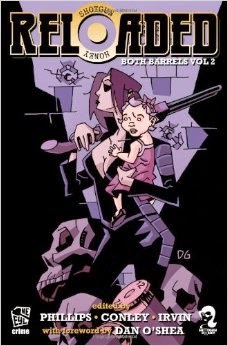
Reloaded by Ron Earl Phillips, Jen Conley and Christopher L. Irvin (editors)


I love short stories, though I don’t get to read as many as I’d like to nowadays. People think that writing a novel is hard, but in my eyes writing a short story and getting everything right is even harder. With a novel you have the time and space to create a whole world and expand on it, whereas with a short story the limited space asks a lot of you, since if you don’t manage to get everything perfectly right you’ll fail.

The first question that comes to mind then is: ‘Did some of the authors here fail?’ Well, let’s say that some did a better job than others. However it would be amiss of me not to say that that is not something unexpected, since once you decide to host 25 authors under a single volume their differences are destined to emerge. On the other hand, especially when it comes to short stories, most of the time taste takes centre stage; what works for me doesn’t work for you and vice versa.

Regardless, I have to say that one way or another I really enjoyed reading this book, as I found bliss in variety. Whilst going through its many stories and meeting dozens of characters I felt like I was taking an interesting and at times funny ride into crime country; a country where everything can and does happen. Once there one meets lethal… hairdressers, dogfights, runaways, Bonnie and Clyde style bandits, hitmen and kidnappers of dead people, bagmen and enforcers.

Trying to choose a favourite story among those on offer in these pages was not an easy thing to do because, as I’ve already said, in the end it all boils down to personal taste. That though doesn’t mean I shouldn’t make a special mention to the ones I enjoyed the most, and those were “How to Clean a Gun” by Joe Clifford, ‘How I Spent My Summer Vacation” by Nick Kolakowski and “What Goes Around” by Terence Butler, a kind of parody with echoes of tragedy, if that makes any sense.

The characters portrayed in the aforementioned stories remain with the readers for long, as they somehow manage to infiltrate their thoughts and stay put. The first is the story of a family whose only law is breaking the law, and its current and permanent victim is a young girl who tries desperately to escape the misery imposed by her mother. The second one talks about a company of young people who seem to have lost their way in the world and seek refuge and fame in crime. And the last is all about a bull of a man who’s desperately in love with a woman that hates his guts and is determined to kill him.

In almost every single one of these stories tragedy seems to await just around the corner. The heroes live in misery, in a world in which only the strong survive while the rest are doomed to vanish. And in most of the cases there’s no redemption to be found anywhere and no hope. People dream of happiness, yet they keep living in sorrow, and they dream of freedom, though none of them escapes their destiny.

If you like crime fiction you’ll surely enjoy this collection. It could be better, that is true, but as someone who’s read a lot of similar books in the past let me say that this is one of the best.

This review was published in Crime Factory magazine

Monday, March 9, 2015

Manto's Review by Ana Zumani


I tenderly exist yet nobody's trained me.
No one asked me to bloom; this “Manto” a Manto has never been.
People welcomed me, not just for the ecstasy of the moment.
They went down to their knees to worship me,
but I always wanted to look to the skies,
at a teacher, who with a stern glance would berate me.
Nobody went through the moves, got into the trouble
-they just showered me with honors-
since being on your knees and worship is easy,
being on your feet and accompany is not,
bowing your head is easy,
keeping it high is not.
I was looking for free people and I found addicts.
They placed their hopes on me,
a life's crumbling wall and so
it wasn't long before that we came to be
crushed under vanity's veil.

A poem I've translated from Greek

Tuesday, March 3, 2015

Love is Looking for a Sally by Maro Vlahaki


The night is dressed in black.
Yet my gray dreams are alight.
In a dreary chamber I am caged,
a blue-painted lamp my only light,
the lantern of expectation seems aged.

The caress is but a graze.
The gaze a wound on parched bread.
Spring is sleeping on sheets of ice,
the years a knapsack hard to heave
and yet love is looking for a sally.

The day is dressed in white.
My dreams the rays of the sun they chase,
and on a blooming pomegranate tree they climb.
As my senses there play and sweat,
to the path of expectation they lead me.

The music is like a caress.
A nightingale's song rings through the streams.
The ivy's shiny green strings,
my lost years together bind.
And thus my love I take for a sally.

Translated from Greek by yours truly.
Image taken by the man himself.
 

Thursday, February 19, 2015

Book Review: Choice Cuts by Joe Clifford


The stories in this collection now and again flirt with various genres though crime has the upper hand. “Choice Cuts” talks mostly about desperate people who lead desperate lives. Happiness is something that you see in the movies, and not that you read about in books, the author seems to think, and I guess that’s the reason why his heroes find themselves in trouble all the time.

Even though this is not your cliché ridden crime story collection, we do get to meet a lot of sad and deluded people within its pages; I say deluded because they really can’t tell what’s true or false and thus they believe what they want to believe, without stopping to think for a moment that things may not be as they seem. So, a cop kills a man thinking that it was the right thing to do, but that was a mistake; a couple of prisoners create the perfect plan to escape but their reasoning is clouded by mischief, exhaustion and hunger; and a man realizes that “…when it looks too good to be true, it usually is”.

I believe that the best thing about these stories, even though they do contain quite a few twists and turns, are their characters, all of whom seem to be living their personal hell on earth. Ray, in “Nix Verrida” is a veteran whose mind is playing tricks on him; how many and how big we don’t get to know until the end of the story. Jimmy is a writer who’s unable to write anything, while Kitty, his girlfriend is sick of him; his not drinking and not writing. Geiger and Donnie are squatters who have a plan to make it big. And last but not least there’s a man who thinks that Leonardo da Vinci is to blame for all his troubles.

“Is anyone in here psychologically sound?” one could ask. Well, the truth is that most of them are not, and that’s what makes their stories so interesting. It’s as if the author, by telling the reader everything about them, tries to make it clear that what happens to them could happen to anyone. All it takes is a major event, or even a minor one at a critical moment, to change somebody’s life forever.

If you’d ask me to choose a story to call a favourite, I really wouldn’t know which to pick; they’re all bleak, and they all talk about loss in one way or the other. “Rags to Riches” with its final twist took me by surprise; “Nix Verrida” made me feel a real sympathy for its hero; “A Matter of Trust” managed to put me into thoughts about the role destiny has to play in our lives; while “Chain Reaction” came to prove that it’s for the best if we don’t rush to jump into conclusions.

Choice Cuts is one of those rear books that have a lot of stories to tell, but in an almost relaxed, laidback way. The author doesn’t seem to try too hard to impress the reader with his writing, or even with his plots. His narratives are plain and simple, so they stick to the reader’s mind, and they make them feel some kind of connection with the heroes. And, I don’t know why but, this book also reminds me about the golden era of noir fiction; the times when the characters build the stories and not the words; when the dialogues were more vibrant and the heroes simple people, just like everyone else.

Joe Clifford did a great job bringing these heroes and their personal stories to life, so reading this collection proved to be a real joy.

First published in Crime Factory magazine

Wednesday, February 4, 2015

Evil and the Mask by Fuminori Nakamura review

 
Evil and the Mask is one of those books that captivate the reader not so much with their plot and action but with the interactions between its heroes in a society that seems to be on the brink of destruction.

Most of the people in the west expect murder and mayhem and high-octane adventures when they read crime fiction. There’s a little bit of the above in this story, but not enough to thrill someone. Instead the author offers a story that talks about the cruelty of a father, the redemption of a son and a love affair that’s bound to go terribly wrong.

The said father, a ruthless businessman, tells his young son, Fumihiro that he’ll become a cancer, a personification of evil under his guidance, and the child feels that there’s darkness inside of him already. He hates his father and he’s determined to kill him one day and thus fulfill his prophecy. Until then though he must do his best to resist his authority and enjoy life a little. Enter Kaori, a young girl who’s adopted into the family, with whom Fumihiro grows up and inevitably falls in love with. He knows that his father will do everything to stop him from being happy, and later rather than sooner decides to take matters into his own hands. Will this pursue of happiness lead him to his doom or will it change his life once and for all for the better?

“Happiness is a fortress,” we read somewhere, and one can rest assured that apart perhaps from the worst of people in these pages, not many can enter it. Instead they keep wandering in the streets of the night, like people with fake faces and mistaken identities; people who have nothing to lose because their lives never really belonged to them.

Fuminori Nakamura, whose excellent previous novel The Thief I've read in one sitting, has his characters interact in peculiar ways. While they’re desperately trying to find their way in an ever changing world, they are held back by the ghosts of the past; while they need love, they thrive in pain; and while they fight hard to be good, they end up exactly the opposite.

As we follow these people we get to learn a lot of things, not only about modern Japan, but also about the loneliness that has become the plague of our times, and the cynicism that seems to drive a lot of people’s actions.

Perhaps this is one of those few special occasions when the title of a book describes perfectly its content. The evil is personified in two people in here; the mask in another two. The characters come alive because the author seemingly keeps his distance from them, and his story is captivating for the simple reason that most of the time things in life don’t turn out as we want them to.

Nakamura chose to narrate his story by moving back and forth in time, thus providing miniscule clues, from chapter to chapter, about how things are going to play out. And yet, because he’s a Japanese author and doesn’t have to abide by the rule of the happy ending, he manages to surprise the reader. You don’t have to be a fan of the genre to enjoy this tale; but even if you are, once you’re not looking for blockbuster fiction you’re bound to love it, as its not larger than life heroes and its simplicity win the day. As a conclusion I’d say that the crime is not so important here, since it only serves as the means that justify the end.

First published in Crime Factory magazine

Tuesday, January 27, 2015

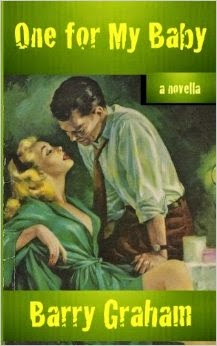
One for My Baby by Barry Graham review


Sometimes it feels good to read a book just for laughs, and One for My Baby is one of those books that are not only fun to read but which can also prove the perfect antidote to boredom, while they can just as well offer some down time to someone who desperately needs it.

The characters in this neo-noir novella are quite interesting. They all seem to come from the past, a time of femme fatales and criminals that took everyday life as a stroll in the park of the outlaws. One could say that they are lovable in a way, but they are also cruel, headstrong, unfaithful but most of all in love with themselves.

It all begins with a robbery. Mark, a musician, robs a restaurant in Phoenix, Arizona, and as expected he finds himself in a big mess. But that doesn’t deter him from going to his cousin’s wedding. Casci, the cousin in question, is a mobster who has some cops on his payroll. And as being the latter’s cousin and a robber is not enough, Mark is also having an affair with a married woman.

Living a life like that more often than not leads to trouble and the more trouble the hero finds himself into, the more fun the reader has. The author approaches his story in a lighthearted manner that gives it a spark and which makes the reading experience all the more enjoyable. Even the secondary characters, like Mark’s partner in crime (whose name I cannot mention because it would be a spoiler), Joel the snitch and detective Rankin, they all have something to add in the storyline and the laughs.

If there’s one thing that I’ve enjoyed more than anything in this story is the way the characters interact with each other. It’s like no one can trust anyone else and like behind every word they utter or every action they take lies something else. Betrayals and double-crossings are hardly unusual in noir fiction, but the author seems to be having way too much fun plotting his heroes’ every move, high points and sudden falls, that in fact the book every now and then reads like a parody, and a good one at that.

You can devour this volume in one sitting and if you are a fan of noir fiction you’ll probably enjoy it just as much as I did. It may not remind you a lot of the masters of the past, but it will help you realize that the noir genre is still alive and well, and evolving by the day.


First published in Crime Factory magazine

Wednesday, December 17, 2014

The Second Deadly Sin by Ã…sa Larsson review


Great crime novels keep coming out of Sweden in particular and Scandinavia in general for the past few years, at a rate that sometimes is hard to follow. What is it that all of sudden made Scandinoir, or Nordic Noir, look so appealing in the eyes of readers all over the world? Is it still because of The Girl with the Dragon Tattoo phenomenon or is it something else? Whatever the reason Scandinavian authors now seem to command our full attention and I for one are happy about itThis is the second book I read by this author and I’m sure that more will follow. Mrs. Larsson has a way of gripping the reader’s attention without seemingly trying to do so. Her heroes are everyday people who are trying to live their lives as best they can. They have families and pets, they have a lot of worries and most of them are torturing themselves psychologically, because they can’t really express their feelings, or because they do what they do out of greed or lust for glory instead for the right reasons.

The reader travels back and forth in time in rural Sweden as they embark on the journey of solving the many riddles at the heart of this story. A not so strange incident is what gives spark to flame and ignites the plot. A bear appears out of the snowy nowhere and attacks a farm. A professional bear hunter is called in to find and kill the animal, which under the circumstances is considered extremely dangerous. That happens sooner rather than later but the bear’s death brings to light a sinister discovery: within its body lie parts of the remains of a man. In the meantime, a woman is killed in her house, while a boy of seven, her grandson, hardly escapes with his life. What is it that connects the two cases?

Well, the perfect candidate for heading the investigation would be District Prosecutor Rebecka Martinsson, who knows the people and the place really well, but an ambitious colleague that goes by the name of von Post hijacks her case. She expects that he’ll make a mess of it, and of course he obliges. Rebecka is furious with her boss for allowing him to do that to her and the case, but at the same time she’s determined to find the truth, even though at first she doesn’t even know she’s doing that.

As we follow her around and through the many flashbacks that spread throughout the story we get to learn a lot of things about the history of the region and its people, but most importantly about the stories of the victims. Rebecka is thorough in her research and a great detective of sorts and that’s exactly what leads her to discover the truth; a truth that was there for her to see right from the start.

The Second Deadly Sin is a crime novel, a psychological thriller and a social commentary at the same time, but most of all it’s a great book and as such I’d wholeheartedly recommend it to all.

First published in Crime Factory magazine

Friday, November 8, 2013

Book Review: How to Draw Cartoons by Lou Darvas


This is one of those books that I really wished I had read when I was a youngster, trying to get his hand around painting something, anything that didn’t look like a scratch on the paper.

While reading the words and going through the simple, yet detailed images I felt like, yes, I could try start drawing again, now that I finally got to know how. This book promises to help the rookie navigate the world of cartoon drawing and it does exactly that, in a straightforward and impressive in its simplicity way. I’d recommend it to everyone out there who’d like to discover the hidden artist in them.

Tuesday, November 5, 2013

Book Review: The Wit and Wisdom of Tyrion Lannister by George R.R. Martin


I have to begin by saying that I’m a huge fan of Mr. Martin and his work and that Tyrion Lannister is one of my all time favorite literary heroes. In fact I’d dare add that I didn’t enjoy A Feast for Crows as much as I should for the simple reason that Tyrion was nowhere to be found.

However, having said that I just have to point out that in my opinion this book came out a few years too early. Since dear Tyrion is still alive and kicking I’m certain that he’d be able to grace us with many more of his witty remarks. Oh well, there’s no use complaining about something that’s already done.

Did this book make me smile? Yes it did, since it reminded me once again what is it that I like about this character. I should also say that the beautiful drawings also capture some of his persona as depicted in the TV series. But, yet again, there’s not enough material in here to keep the fans happy.

Perhaps the next book published in this vein should be The Transformations of Arya Stark, who’s not a lady but a wolf.