Showing posts with label japanese writers. Show all posts

Tuesday, January 5, 2016

My (Previous) Year in Reading: 11 to 20


…in chronological order.

2015 has been a great year when it comes to reading books for me. During it, according to Goodreads, I have gulped down 212 volumes that were not only novels for adults but also volumes that belonged in many other genres: YA, graphic novels, poetry, children's stories, short stories and books in translation. This has also been a year that I stopped writing reviews since I had much else occupying my mind and time, so below I'll give you no more than a few words about the books I have read. I hope some of my choices echo yours and I look forward to an exciting new year of reading. 

11) Confessions by Kanae Minato. This book, to put it simply, is absolutely great. The author did a trick on me, as I'm certain she did on many other readers. If you like mysteries with many twists and turns and really unexpected endings, then you'll love this. Easily one of my best ten reads of the year.


12) Spectacle: Stories by Susan Steinberg. It's almost impossible for me to award five stars to a short story collection, but I did it for this one and for one by Alice Munro. These stories discuss the big questions in life; love, loss, difficult choices, revelations and secrets left untold. Her writing is exquisite and she's definitely a writer to look out for.

13) The Great Race: How the Chinese Zodiac Came to Beby Stacey Hirata and Charles Huang. This is a really fun book to read with your children. The plot is simple and the story straightforward, and I guess more or less the title explains it all. Reading it me gave me a lot of smiles and also taught me a little bit on the way I guess. Lovely.

14) The Wild Book by Margarita Engle. This is yet another children's book that I really loved. Its subject matter is not light but the author manages to make it sound fun and interesting to all in a playful manner, using beautiful prose that captures the reader's heart. Dyslexia is the name, getting over it is the game. Highly recommended.

15) Hold Your Own by Kate Tempest. I have to admit that I'm a big fan of KT, whom I discovered from a Guardian piece and her youtube videos. This poetry collection was almost all expected from her, as she uses simple words and straightforward language to talk about today's world. Some of the poems are better than others, a few of them are really great. The fact is that I've enjoyed reading most them so much that I sat myself down and translated the whole volume to Greek. Unfortunately, unless a miracle happens, it is never going to be published since, a) I'm not well connected when it comes to Greek publishers, and, b) The Greek market is on its deathbed after the last economic downturn. Oh well, at least I enjoyed the journey.

16) Poems Without Name by Dulce MarĂ­a Loynaz. I have bought this book 14 years ago in Cuba and I have read it three times since then. The poet is one of the most famous in her country and, though dead now, still waits to be discovered by the rest of the world. If you like poetry that talks about the things that matter not only on a personal but also a societal level, then this book can work wonders for you.

17) Pine and the Winter Sparrow by Alexis York Lumbard and BeatrizVidal. This is an old story told anew in beautiful prose and accompanied by wonderful illustrations. A children's story it is, but it can be read with pleasure by everyone. In these pages we watch birds and trees as they interact with each other and in the end we get to know why the pine trees are one of the few that stay green all year around.

18) Stories of Havana by Estrella Fresnillo. I bought this short story collection during that trip to Cuba as well, and I really enjoyed it. The stories here are quite simple. They are stories about people and their everyday lives. Stories that can make you smile or make you sad. The author seems more interested about the myth than the plot and that works just fine here.

19) Swamp Bones by Kathy Reichs. This is an original ebook novella that sees the famous forensic anthropologist Temperance Brennan travel to Florida for a short holiday that was never meant to be. Human bones are found in the stomach of a Burmese python, and Temp, feeling certain that foul play was involved throws herself into full investigative mode. One of the author's better works, a fact perhaps helped by the size of the book.

20) Three Twisted Stories by Karin Slaughter. (Beware: This is the AUDIO version. You can seek the ebook elsewhere.) I don't think that there are many authors that do twisted as well as Karin Slaughter does. I won't go into details about the three stories that are included in this small collection, but I will say that they achieve their goal, which is to upset the reader, seemingly without great effort. KS reminds me of some Japanese masters of the genre.
 

To be continued 

See also: 1 to 10
 

Wednesday, February 4, 2015

Evil and the Mask by Fuminori Nakamura review

 
Evil and the Mask is one of those books that captivate the reader not so much with their plot and action but with the interactions between its heroes in a society that seems to be on the brink of destruction.

Most of the people in the west expect murder and mayhem and high-octane adventures when they read crime fiction. There’s a little bit of the above in this story, but not enough to thrill someone. Instead the author offers a story that talks about the cruelty of a father, the redemption of a son and a love affair that’s bound to go terribly wrong.

The said father, a ruthless businessman, tells his young son, Fumihiro that he’ll become a cancer, a personification of evil under his guidance, and the child feels that there’s darkness inside of him already. He hates his father and he’s determined to kill him one day and thus fulfill his prophecy. Until then though he must do his best to resist his authority and enjoy life a little. Enter Kaori, a young girl who’s adopted into the family, with whom Fumihiro grows up and inevitably falls in love with. He knows that his father will do everything to stop him from being happy, and later rather than sooner decides to take matters into his own hands. Will this pursue of happiness lead him to his doom or will it change his life once and for all for the better?

“Happiness is a fortress,” we read somewhere, and one can rest assured that apart perhaps from the worst of people in these pages, not many can enter it. Instead they keep wandering in the streets of the night, like people with fake faces and mistaken identities; people who have nothing to lose because their lives never really belonged to them.

Fuminori Nakamura, whose excellent previous novel The Thief I've read in one sitting, has his characters interact in peculiar ways. While they’re desperately trying to find their way in an ever changing world, they are held back by the ghosts of the past; while they need love, they thrive in pain; and while they fight hard to be good, they end up exactly the opposite.

As we follow these people we get to learn a lot of things, not only about modern Japan, but also about the loneliness that has become the plague of our times, and the cynicism that seems to drive a lot of people’s actions.

Perhaps this is one of those few special occasions when the title of a book describes perfectly its content. The evil is personified in two people in here; the mask in another two. The characters come alive because the author seemingly keeps his distance from them, and his story is captivating for the simple reason that most of the time things in life don’t turn out as we want them to.

Nakamura chose to narrate his story by moving back and forth in time, thus providing miniscule clues, from chapter to chapter, about how things are going to play out. And yet, because he’s a Japanese author and doesn’t have to abide by the rule of the happy ending, he manages to surprise the reader. You don’t have to be a fan of the genre to enjoy this tale; but even if you are, once you’re not looking for blockbuster fiction you’re bound to love it, as its not larger than life heroes and its simplicity win the day. As a conclusion I’d say that the crime is not so important here, since it only serves as the means that justify the end.

First published in Crime Factory magazine

Thursday, January 17, 2013

Book Review: Revenge by Yoko Ogawa


Yoko Ogawa is one of my favorite Japanese writers. Her novels are more often than not bleak, she describes worlds and lives where usually things tend to go wrong. And there’s a kind of sadness throughout her narratives; a sadness that somehow manages to make the reader smile. Reading a Yoko Ogawa story is like watching a House M.D. episode as Dr. James Wilson announces to a patient that he’s going to die and the latter thanks him for it.

Revenge (out on January 29, 2013) is the first short story collection by the author that comes out in English, even though I am not quite sure I can call it so. The eleven tales included in this volume are in one way or another connected with each other. The author plays with voices and the timeline, as she takes the reader from head to head, from situation to situation.

For some reason there are no happy endings in these stories, and maybe that’s exactly what makes them so special. We read about everyday lives, but highly unusual ones. We get to visit a garden where carrots that have the shape of hands grow, a museum of torture, a deserted zoo, a hospital, and a high-end hotel. As we follow the heroes from place to place, from sorrow to sorrow, the interest mounts, making us feel that desperate people are doomed to lead desperate lives.

“The room smells of death and disinfectant,” we read in Lab Coats, but the truth is that the whole book smells of death. There are no heroes here, only antiheroes. As they traverse from tale to tale, and narrate their own sad stories, death seems to follow their every step. Most of them are eccentric. One is an inventor of sorts that somehow becomes a museum curator; another is a painter, and one of the most important ones is an author. And somehow they all seem to have reached a dead end in their lives.

Maybe it’s the city, the hectic pace of life that makes them feel at a loss, but maybe not, as they do find the time to go places, sit still in a bakery and reminiscence, spend some time at a hotel, or even take care of a Bengal tiger.

The author has a unique way of placing people together at one place or another, at connecting the dots of their lives together, without even showing that she’s doing that. It’s as if she’s trying to say that we are all fragmented people, leading interconnected lives.

The prose is as beautiful as it could be, and having read some of Ogawa’s books both in Greek and English I can say that Stephen Snyder did a great job with the translation, since the stories at hand read like they were originally written in this language. This tome was a joy to read and I’m certain that I’ll return to it in the future.

Tuesday, June 26, 2012

Banana Yoshimoto


Some authors we simply like; with some others we feel like they speak straight to our psyches; a few of them we despise; and a special few we simply adore. For me Banana Yoshimoto falls into the latter category. I adore her. I adore her stories, her writing, her women and her modesty.

I remember that the first book of hers that I’ve ever read was Kitchen, back in 1995 or 1996, when I used to live in Athens, Greece. What I really liked was not the myth or the plot of her stories, but their simplicity. Yoshimoto doesn’t write too much and then subtract, she just doesn’t like to talk, or rather write, too much. She, in my mind’s eye, seems to think there’s no reason to tell a story in a hundred pages when she can say it in fifty. And it’s exactly this frugality of her books that makes them stand out. While reading her prose, you never get the feeling that the author is an intellectual; she’s just a story-teller, and a very good one at that.

One would say that the common denominator in all her books are her heroines: some desperate souls, full of passions and prone to mistakes, who have great or not so big dreams, who, one way or another, seem to seek some kind of fulfillment. More often than not they are kind-hearted women, who seem to have suffered a lot in the hands of destiny, but some of them are pure evil as well. These women make unlikely heroines, mostly because they are so common, as common as most of those that live outside the page. They talk about simple things, like their everyday reality, about their lives and their passions; and they discuss important things, like love and loss, their families and the heavy shadow of death.

There’s just one more element that plays a really big role in her stories; that of the paranormal. In her stories people every now and then talk with the dead, there are ghosts coming and going, and time travel is not something out of the ordinary. The good thing though is that the author doesn’t really seem to think that the ends justify the means; she doesn’t try, at least not too hard, to impress or surprise the reader. It’s as if she just wants to point out that the paranormal is no more than a simple part of life.


If there’s a thing that the Japanese authors excel in, is in writing novellas. This, let’s call it genre of literature, really suits them fine. From Ryu Murakami to Shusaku Endo and from Yukio Mishima to Amy Sakurai and even the famous Haruki Murakami at times, all these masters of the written word try to tell the stories of simple people and their struggles with life, in as few pages as possible. Now, most of them have written long novels as well, and so did Yoshimoto with Amrita. The thing is that she claims that she’ll probably never do it again. And I don’t blame her. The novella is her kingdom. And what a beautiful kingdom it is: rich in passions, full of empathy, a martyr to the big joys and the grant sorrows of life; a kingdom that breathes meaning into the word Humanity.


Banana Yoshimoto’s Books in English translation:

The Lake. You can read my review here and quotes here.
Asleep
Kitchen
Hardboiled and Hard Luck. You can read quotes here.
Lizard. You can read quotes here.
Goodbye Tsugumi. You can read quotes here.
NP
Amrita


Wednesday, March 28, 2012

Book Review: The Thief by Fuminori Nakamura


As the title suggests in this book we have the story of a thief; but not a thief like everybody else, but one with a conscience.
     The action begins straight away as we watch our protagonist and narrator pick the wallet from the pocket of a rich man at the train station, while his next victim, a not so rich man riding the train is soon to follow. When it comes to pick-pocketing he’s a master, however lately things don’t seem to go as smoothly as they used to go. He keeps following his mentor’s rules, stealing only cash and returning the wallets along with the credit cards to the rightful owners by mail, but somehow he now feels different, kind of unfulfilled, and he becomes really absent-minded. He also starts having short black-outs, during which he steals wallets without even realizing it, and he feels more sad by the day. It’s as if there’s a void inside of him that keeps growing and expanding, along with his loneliness: “I had built a wall around me and lived by sneaking into the gaps in the darkness of life,” he says.
    Well, that wall now seems to be coming tumbling down. But maybe he’s not to blame for what is happening, but just life and its harsh realities. His fall from grace starts when Ishikawa, his mentor, asks for his help for a job unlike any other they’ve ever been involved with: an armed robbery. They do manage to have the job done, but from that point on there seems to be no way for them to return to their previews lives, since their employer for that particular job was a ruthless and fearless mob boss who was not willing to let them go; at least not alive. The protagonist who now has to cope with this new reality, whether he likes it or not starts to contemplate his life and his choices, and where the latter now lead him. As a pick-pocket he’s great, but apart from that what else does he have or has he done in his life worth mentioning? Apparently nothing, or maybe just something, or somebody; somebody from the past, Saeko, a woman he used to love. However, the past is the past, now he needs to find something or someone to help him hold on to today. What, or who, could that be?
     As it turns out he’ll meet his new project in the faces of an unconventional team of thieves, a mother and her very young son. He’ll spot the two of them as they’ll be trying to steal some things from a supermarket and he’ll save them from certain catastrophe; the amateurs. From that day onwards he’ll feel like his life has finally found its purpose, or rather he’ll rediscover his will to live. In the face of the young kid he’s certain that he met a younger version of his own self and he’s determined to help him create a better future for himself. And even though, at the kid’s insistence he’ll teach him some of his tricks, at the same time he’ll try to save him from his miserable life. By saving the kid he saves himself, and by opposing and coming into conflict with his disgrace of a mother, in the end he becomes the person that he’s actually always been; a good man.
     This is a well-written novella, which even though it seems to belong under the crime fiction label, reads more like a psychological drama than a thriller.

Thursday, June 30, 2011

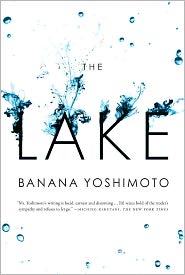
Book Review: The Lake by Banana Yoshimoto


“Say it simple, stupid”; this could definitely be the message that the author is trying to convey to the reader; or rather to the other writers. If there’s a canon in Yoshimoto’s writing that’s simplicity. She just tells a story and she tells it briefly and beautifully; her words flow like a quiet spring stream. With the exception of Amrita all her books are small in size, but full of meaning. By using a few words and characters that have much in common, book after book, she seems to be writing time and again the same story, but that’s not really the case. The author is mostly interested in the lives of people, in their psyches, and she’s not trying to win the reader over with the plot, but with the words and actions and maybe, every now and then, just the thoughts of the protagonists.
     The Lake tells the story of an, in a way, unconventional love affair. Two lonely young people exchange glances and waves from a distance and just wonder what meeting each other would be like. Chichiro, is desperately trying to get over the death of her mother, which casts a heavy shadow over her whole being, while Nakajima seems to be struggling hard just to go on living. Everyday life may seem like a burden to them, but what they lack in joy they have in talent and in brains. The woman is a very talented and inspired mural painter, while the man is highly intelligent and hopes one day to make a name in the field of nanotechnology. Sooner or later they are going to meet, and little by little everything will start to change for them, as the one will come to find in the face of the other, in an almost whispered way, the perfect companion. Through their deeds and their many discussions we’ll come to discover some hidden aspects of their inner lives, and also have the chance to take a good look at the modern day Japanese society; a society where time is money and everything can be sold and bought, a society of plenty; just before the economic crash brought things upside down, that is.
     Being together though doesn’t mean that their problems are magically solved. As Nakajima is trying to move forward with his plans, while at the same time harboring thoughts of death, Chichiro is still working with her psychological issues. Time and again she thinks about her dead mother and her estranged father; “I guess my mom was all he had – the one flower that smelled like freedom”, she says, to add later on, addressing directly her mother: “…you were like a blossom softly unfurling its petals on a cliff somewhere”.
     The two young people, even though they now have someone to lean on, continue nevertheless to feel kind of lonely; subconsciously they are still kept grounded by the chains of yesteryear. They both know that they have to do all they can to escape their demons; but what? He actually knows what he has to do, but he needs her help to do it; a help that she’s more than happy to provide. So they set out on a trip to the country, to visit a house, or rather a hut by a lake, where two young people, a brother and a sister reside. Being there with him, meeting these strange people, Mino and Chii, feels like a surreal experience to her, as for the first time, she comes to learn something very important about Nakajima’s past. He, on the other hand, having finally done what he always wanted and needed to do, now feels free to go on living, as if all his burdens have been lifted. From that day onwards their common life will change for the better; a kind of serenity will settle in between them and they’ll start to confide to each other everything, discuss matters more openly, share their big musts and must not’s, and at last start loving each other for who they really are. “This is what it means to be loved… when someone wants to touch you, to be tender…” Chichiro says, even though she doesn’t hesitate to admit that at the time, “what I felt for him wasn’t exactly love, it was closer to a sense of surprise, even shock”. Of course that was only because he had “the intensity of a person unafraid of death, at the end of his rope”.
     This finely crafted tale talks in a straightforward way about a person’s need for love and companionship; but also about loneliness, which can be turned into a noose and choke the will to live out of everybody. This book can be read, and excuse me for the metaphor, like a ballad; a ballad about the complexity and simplicity of the everyday life, and of the young souls. I dare say that this is one of the best novels, by one of the best writers that ever came out of Japan.

Saturday, June 18, 2011

Quotes from The Lake by Banana Yoshimoto

“When things get really bad, you take comfort in the placeness of a place”

“All my life I cherished the possibility of escape”

“Everything in life has some good in it. And when something awful happens, the goodness stands out even more”

“If you are always angry, always yelling at people, ultimately that just means you depend on them”

“… (Mom) you were like a blossom softly unfurling its petals on a cliff somewhere…”

“This is what it means to be loved… when someone wants to touch you, to be tender…”

“I love feeling the rhythm of other people’s lives. It’s like traveling”

“When you’re in a state of homogeneity, it means you’ve lost yourself”

“You see things through the filter of your own sensibility”

“Who says that you can’t warm your frozen limbs in the faint heat of a flicker of hope?”

Buy at Amazon

Friday, May 13, 2011

Book Review: Snakes and Earrings by Hitomi Kanehara


Snakes and Earrings is not a book for the tenderhearted; even though it does become tender every now and then. Actually this is a very harsh story, talking about a hard world; the world of Lui, Ama and Shiba-san. It’s a story about a different way of life; a way of life that breaths and breeds in the darkness of the human soul; of life without hope.
     The three heroes live inside this world of ours, but mostly at the side of it. They know everything about its conventions, but they do not abide to them. They are just themselves and the road to destruction is paved by their own hand.
     It all begins when Lui, a kind of a Barbie girl with as many earrings as one can get, meets Ama, a total freak who has even more piercings on his body than her. They hit it off right away and before too long she moves in with him. What did she find so attractive about him? What else did you expect but his forked-tongue and his tattoos? She’s mystified by this creature. And she feels jealous. She needs a tongue just like his. But not only that; she also wishes to have engraved on her body the most original tattoo anyone ever made. It’s exactly because of her dark wishes that she finds her way, along with Ama, into the workshop of Shiba-san, a real master in the arts of piercing and tattooing. As she walks through that door, the floodgates of hell seem to open wide and the oncoming waters are bound to rush her into the abyss.
     Lui is an extreme character. She likes falling down psychologically time and again; to dive in with no regrets into the worlds of sin; to torment her body without giving it a second thought. She seems to live in order to suffer, and it’s exactly this pain that keeps her alive. She may be an item with Ama but she doesn’t hesitate to sleep with Shiba-san; even after he says that he really wants to kill her. At the same time she feels almost ecstatic at the idea of her forked-tongue. Actually she’s so eager to get it that she places herself into a spot of insurmountable pain; almost flirting with insanity. Ama, despite his looks, is quite a sensitive man and he really loves Lui. He hates watching her doing bad things to herself but doesn’t seem to have the power to stop her. He’d even kill for her; if she didn’t kill herself first that is. As for Shiba-san, well, he’s a man without a trace of humanity in him. He likes inflicting pain and that’s probably why he’s doing what he’s doing for a living. However, maybe, just maybe, he’s not completely lost, and a tragic event is all that it will take to bring some samples of goodness out of his dark heart and into the light.
     Snakes and Earrings is mainly a book of characters. The plot is not so important. The author doesn’t treat her creations with a gentle hand by with extreme harshness. She has a story to tell, and she’ll stop at nothing, in order to do so. The modern Japanese society comes under the microscope, goes through her fine filter and comes out at the other side just as bad as it could ever be. Sex, violence, drugs, alcohol, prostitution, fears; she talks about all these matters in a masterful way, in a raw language that could be hard to cope with, but which is the only one that could describe things as they really are.
     This is a hell of a novel, about the hell of some people’s everyday lives.

Friday, April 29, 2011

Book Review: Where Europe Begins by Yoko Tawada


As the acclaimed director Wim Wenders points out at the forward, this book could have only been written by a Japanese. And a great book it is.
     Where Europe Begins is a collection of short stories that someone, anyone really, could call postmodern. Dream and reality, fantasy and life, legend and history seem to be bounded together in harmony in these narrations. The author seems to be playing games with us and her heroes, winking an eye every now and then and saying: Nothing really is what it seems.
     The collection opens with The Bath, a story where the main characters change roles or maybe costumes all the time; as if they are only faces distorted by the mirrors of reality or, in a strange way, just like puppeteers.
     The Reflection, which follows, is extremely poetic and talks about the drowning of Buddhist monk in a small lake and a young girl’s connection to him.
     In Spores, the writer seems to find herself in an acrobatic exhibition, walking the tightrope of words, meanings, dreams and reality, while in the Canned Foreign we start on a journey to language and its wealth, with the precious help of Sasha and Sonia.
     Gilda, a woman full of fears and insecurities, is the main character in The Talisman. She does nothing but collect talismans, which will supposedly protect her from the alien that hides inside her own body, or in the computer, or even in her soup.
     Raisin Eyes is a story that sounds funny but it’s not. It’s the story of a girl, whose father became a woman after eating some fresh bread.
     Storytellers Without Souls is more like an essay about language, hearing and narration, than a short story. Written in a kind of light way it’s a pleasure to read.
     The title of the next story tells it all: Tongue Dance. Through this weird story the writer allows us to take a look into a world of total paranoia, where we meet a girl that dreams that she’s been transformed into a giant tongue.
     One of the very best (if not the best) stories in this collection is the one that gives it its title. A young woman starts off from Japan for a long sea and land journey towards Europe; or rather towards Where Europe Begins. The narrator starts writing her travelling journals even before the trip begins, in order to know what to say next. The narration here seems fractured, constructed by bits and pieces that hold it together lightly, moving forth and back all the time, mixing myth with reality. During the long journey we come to learn a few things about the Sleeping Land (Siberia), its people and their traditions.
     We come to the end with A Guest, which tells the story of a woman that visits the doctor because of a severe pain in the air, only to find out that she’s pregnant. As if that’s not enough she then goes on to buy a book, which turns out to be tapes. In these tapes someone is reading the book so that’s not too bad after all. Or is it? As it seems it actually is, since sooner than later the sound of that voice will start driving her crazy. She’ll hear it all the time, whether she plays the tapes or not, day and night. Left with no other option and in her struggle to survive she’s trying to do the only thing she can do; abolish the alphabet. In this story every boundary seems to be coming tumbling down and one can no longer tell what is real and what is not.
     Where Europe Begins is one of the best short-story collections I’ve read lately and Yoko Tawada is in her own special way a superb storyteller. Highly recommended.

Monday, April 18, 2011

Book Review: Kafka on the Shore by Haruki Murakami


Kafka on the Shore is the first book by Haruki Murakami that fell into my hands and, even though I came to read more than a handful of his novels and short stories, I still consider Kafka on the Shore his best offering. I used to have my doubts about the merit of his work since the man is a star, but after reading this great novel I came to realize that he more than deserves his popularity.
     The main characters in this book are actually no more than two: Kafka, a fifteen year old, who runs away from home before he “explodes”, and Nakata, a somewhat mentally challenged old man who’s a professional cat detective. These two diametrically different people are bound together with an unseen thread, which obsoletes time and turns the worlds of yesterday and today into one. They are in the centre of the plot, or rather they are the plot, but we also see a few other people hanging about or around, which have some important or not so important role to play in the story: the androgynous librarian Oshima that takes Kafka under his protective wings, just when the youngster arrives at the city; miss Saeki, who seems to be the link between the present and the past; the enigmatic man that goes by the name of Johnny Walker and drives Nakata to the limits of despair; and Hoshino, who for no apparent reason at all, and without giving the matter a second thought, decides to follow Nakata on his quest.
     Murakami delivers a story that could be read as a fairytale; where people and times seem to merge together and where mystery sets the ground rules; where the answer to every question is always close at hand, but not the one we expect it to be. His heroes are people with passions and secrets; kept hostage by feelings of guilt and loneliness. They are as lonely as one can ever get. What if they cross paths? What if they feel at a time or another that they are close to each other? In the end it is the loneliness that prevails; it is only in isolation they can exist. The only one of them who seems to have a chance to break the rule is Nakata; because he lives every day as it comes; because, despite his desperate poverty, he is a symbol of the most simple and true values in life, values he can put into words, words he can put into action; unlike Oshima. The latter, a modern day philosopher, somewhere says: “Gays, lesbians, straights, feminists, fascist pigs, communists, Hare Krishnas – none of them bothers me. I couldn’t care less about the kind of banner they hold. What I cannot stand are empty people…”
     Fate has some sad times in store for the heroes of this story; but it is fate that in the end brings about the final solution. As the boy that goes by the name of Crow, (Kafka in Czech), says: “Sometimes fate looks just like a small sandstorm that changes direction all the time. You change course and it follows you. You turn elsewhere and it adjusts”.
     This book is just like a journey around the two distinct worlds of the souls and of fantasy; a trip into the regions of truth that cannot find their place in the colorless reality we live in. An enjoyable read, by a master storyteller, which every now and then just seems to take the reader’s breath away. Pure magic.

Thursday, March 3, 2011

Hitomi Kanehara – Autofiction Quotes

What is hysteria, after all? It’s a disease of the pussy.

I live with the sole purpose of making my boring life even more boring by providing a boring commentary for my everyday boring life through a boring voice in my head.

I need to stay calm. Restrain myself. I have this tendency to think I’m right and make others feel bad. I need to remember that even I’m wrong sometimes.

There is really no point in basing one illusion on another.

Nobody has a time or place where they are free from the danger of death. People forget that, People live their lives with the basic assumption that they will still be alive the day after. I can’t live like that.

To love is to die.

Anger is similar to maggots. It multiplies in no time at all and quickly reaches an uncontrollable state.

I’ve chosen a life in which there is no place for excuses.

I’m living my life as a kite that has no home to go to.

Endurance is what my life is all about… I basically need to endure every moment of my life…

Perhaps hell is a fun place and even fun places can be hell, or perhaps hell is turning into a fun place day after day.

Wednesday, March 25, 2009

Yoko Tawada – Where Europe Begins Quotes

Sometimes other people’s skulls look transparent. At such moments I fall in love.

They say hair is the part of the skin that has died and hardened. Part of my body is already a corpse.

I was trying to preserve my body from death by burning it onto paper.

People’s mouths fell open like trash bags, and garbage spilled out. I had to chew the garbage, swallow it, and spit it back out in different words. Some of the words stank of nicotine. Some smelled like hair tonic.

No work is more exhausting than sleep.

…My mother asked, “Why don’t you cut your hair? They say the god of death can grab hold of long hair.”

I am a transparent coffin.

The moon no one sees belongs to yesterday.

Something no one sees can’t be wrong.

Perhaps some books do scream when they’re torn apart.

When a person smells different, it’s as if she’s altogether a stranger, and one becomes a little shy.

It’s strange the way the expression of a foreigner’s face is often compared to a mask. Does this comparison conceal a wish to discover a familiar face behind the strange one?

Sometimes two people sat down next to each other in a café, and thus, briefly, formed a word. Then they separated, in order to go off and form other words.

I wish I were made of raisins. In the language of raisins I say: do not call me by a place name. Do not give me women’s shoes.

The claim that a person who writes is not truly living can only be made by someone who sees a person and his life as subject and object. He might say the most important thing is to live one’s life. I would say: I live and my life lives as well. Even my writing lives.

There are people, though, who assume that everyone is given an original text at birth. They call the place where these texts are stored a soul.

In a book about Indians I once read that the soul cannot fly as fast as an airplane. Therefore one always loses one’s soul on an airplane journey and arrives at one’s destination in a soulless state… In any case, this is the reason why travelers most often lack souls. And so tales of long journeys are always written without souls.

To cut off a person from the world, you must first destroy not his mouth but his ear.

How strange! In order to read, I have to look at the text. But to avoid stumbling, I have to pretend the letters don’t exist. This is the secret of the alphabet: the letters aren’t there any longer, and at the same time they haven’t yet vanished.

The books can never forget their readers, though the readers have no doubt forgotten all about the books’ contents.

I had always found it unpleasant to have guests in my apartment. They filled up my rooms with strange sentences I would never have formulated in such a way.

For me, my apartment had the function of a skin. No one could observe it from the inside.

Buy the book: Where Europe Begins (New Directions Paperbook)