Showing posts with label banana yoshimoto. Show all posts

Thursday, October 3, 2013

10 Favorite Books

This is the second list I present in this blog, and hopefully more will follow in the coming weeks. As one can guess from the title this is a list of 10 favorite books, but not The List. I have read thousands of books over the years, some new, some old, and a few ancient, so one list would never do them justice. Below you will find books that I’ve read during the last few years, and which I’d place under the label of Modern Literature. Most probably I’ll compile another couple of lists under the same label, and also, at least, one consisting of classic titles. I know that some of my selections will look strange in your eyes, but every reader is different, and good fiction has many champions out there. Now, where shall I begin? Oh, this will do…


1.    Please Look After Mon by Kyung-sook Shin. I had this book on my eReader for a long time. I knew the story, I’ve read great reviews about it, but somehow I always chose something else over it. That was until that blessed day came when I started reading and everything changed, as I found myself in reader’s heaven. If you love stories with a heart, you’ll love this book. Read my review here.


 2.    The Secret Scripture and On Canaan’s Side by Sebastian Barry. I know that I’m cheating by placing two books by the same author in the list, but Barry is such a good writer that I don’t have too much of a choice. I remember that when I’ve first read The Secret Scripture I kept thinking, ‘No, I’m not a writer,’ since if I were to compare myself to Mr. Barry, well… You can see my review in Greek (yeah, I know, this sucks) for the latter here, while you can read about On Canaan’s Side in English right here.


 3.    Kitchen by Banana Yoshimoto. This is the book that made me fall in love with Japanese Literature. It consists of two novellas, the eponymous Kitchen and Moonlight Shadow. Yoshimoto is one of those writers that can easily find their ways into a reader’s heart. All her books, with the exception of Amrita, are quite short, but while reading them you always find yourself traveling into another world; a world full of thoughts, emotions, dreams, and magic. I apologize again but I don’t have a review in English. You can find one in Greek here, while you can read what I had to say about her latest book The Lake, if you follow this link.


 4.    Ocean Sea and Silk by Alessandro Baricco. Here I go cheating again. I am so so sorry. No, I am not. The truth is that I couldn’t choose between these books. The first I’ve read 14 years ago while staying at the island of Karpathos in Greece, and it got stuck in my head ever since. The second I’ve only read a couple of years ago and it rekindled my interest in Baricco’s work. Here we have an Italian author that is a master of emotions and one of the best storytellers to walk the shores of his land in the last century or so.


 5.    A Game of Thrones by George R.R. Martin. A friend suggested Mr. Martin’s work to me a few years ago, and since I started reading him I never looked back. He is one of the finest storytellers of our times. His prose is beautiful and fluid, his action sequences are amazing, his plots are quite intriguing, while I also enjoy his sense of humor. I don’t think that many writers could produce a thick volume like A Feast for Crows, which is something like a link connecting two parts of the great story, and get away with it... in one piece. Anyway, if fantasy (and popular) fiction can be as good as this, then I say that I’m faithful fan of the genre(s).


 6.    Paddy Clarke Ha Ha Ha by Roddy Doyle. Well, it’s always good if someone laughs every now and then, and if you read this book you’ll laugh a lot. Roddy Doyle is a great author, who’s not always at his best, but Paddy Clarke Ha Ha Ha is considered by some as a modern classic and I totally agree with them. Perhaps I should add a book or two as companion reads, but there’s plenty of time to do that in the future.


 7.    Kafka on the Shore by Haruki Murakami. I can’t explain why but this is my favorite Murakami novel. Everyone else is talking about Norwegian Wood or the Wind-Up Bird Chronicle but for me the author has reached the peak of his creativity with the book at hand. There’s no need to expand on it since you can read my review here.


 8.    No one belongs here more than you by Miranda July. Wow! What the fuck! Amazing! Yes, yes, yes! These are just a few of the expressions I’ve used while reading this great collection of short stories by the multitalented Miranda July. As I was going through her stories I felt as if she was talking directly to me, and I kept thinking that I should have been the author of most of them. As it seems Mrs. July lives in my head (and that’s not a good place to be; honestly).


9.    Pedro Páramo by Juan Rulfo. Pedro Páramo is one of those books that I call ballads; a novella that talks about people and their troubles, their everyday lives, their hopes and their fears, and about love. And much more. How much can you say in a few pages? Too much actually, if you know how to say it.Someone could call this book "experimental". Somebody else could say that it's "crazy." However, no one could possibly state that it is not an important one, since largely it is thanks to it that the magical realism of Latin America came to be.


10.    The Savage Detectives by Roberto Bolaňo. The late author was as good as they get. His knowledge was wide, his technique absolutely stunning, and his prose, at moments, simply breathtaking. The Savage Detectives is a book in love with books, but it’s also a journey, into the wilderness of a land and an era, into the joy and failures of youth, and into the abyss of the human soul. If you ever asked yourself, what is that special thing that makes literature great, all you have to do is read this novel and to get your answer.

Tuesday, June 26, 2012

Banana Yoshimoto


Some authors we simply like; with some others we feel like they speak straight to our psyches; a few of them we despise; and a special few we simply adore. For me Banana Yoshimoto falls into the latter category. I adore her. I adore her stories, her writing, her women and her modesty.

I remember that the first book of hers that I’ve ever read was Kitchen, back in 1995 or 1996, when I used to live in Athens, Greece. What I really liked was not the myth or the plot of her stories, but their simplicity. Yoshimoto doesn’t write too much and then subtract, she just doesn’t like to talk, or rather write, too much. She, in my mind’s eye, seems to think there’s no reason to tell a story in a hundred pages when she can say it in fifty. And it’s exactly this frugality of her books that makes them stand out. While reading her prose, you never get the feeling that the author is an intellectual; she’s just a story-teller, and a very good one at that.

One would say that the common denominator in all her books are her heroines: some desperate souls, full of passions and prone to mistakes, who have great or not so big dreams, who, one way or another, seem to seek some kind of fulfillment. More often than not they are kind-hearted women, who seem to have suffered a lot in the hands of destiny, but some of them are pure evil as well. These women make unlikely heroines, mostly because they are so common, as common as most of those that live outside the page. They talk about simple things, like their everyday reality, about their lives and their passions; and they discuss important things, like love and loss, their families and the heavy shadow of death.

There’s just one more element that plays a really big role in her stories; that of the paranormal. In her stories people every now and then talk with the dead, there are ghosts coming and going, and time travel is not something out of the ordinary. The good thing though is that the author doesn’t really seem to think that the ends justify the means; she doesn’t try, at least not too hard, to impress or surprise the reader. It’s as if she just wants to point out that the paranormal is no more than a simple part of life.


If there’s a thing that the Japanese authors excel in, is in writing novellas. This, let’s call it genre of literature, really suits them fine. From Ryu Murakami to Shusaku Endo and from Yukio Mishima to Amy Sakurai and even the famous Haruki Murakami at times, all these masters of the written word try to tell the stories of simple people and their struggles with life, in as few pages as possible. Now, most of them have written long novels as well, and so did Yoshimoto with Amrita. The thing is that she claims that she’ll probably never do it again. And I don’t blame her. The novella is her kingdom. And what a beautiful kingdom it is: rich in passions, full of empathy, a martyr to the big joys and the grant sorrows of life; a kingdom that breathes meaning into the word Humanity.


Banana Yoshimoto’s Books in English translation:

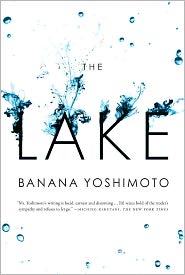
The Lake. You can read my review here and quotes here.
Asleep
Kitchen
Hardboiled and Hard Luck. You can read quotes here.
Lizard. You can read quotes here.
Goodbye Tsugumi. You can read quotes here.
NP
Amrita


Thursday, June 30, 2011

Book Review: The Lake by Banana Yoshimoto


“Say it simple, stupid”; this could definitely be the message that the author is trying to convey to the reader; or rather to the other writers. If there’s a canon in Yoshimoto’s writing that’s simplicity. She just tells a story and she tells it briefly and beautifully; her words flow like a quiet spring stream. With the exception of Amrita all her books are small in size, but full of meaning. By using a few words and characters that have much in common, book after book, she seems to be writing time and again the same story, but that’s not really the case. The author is mostly interested in the lives of people, in their psyches, and she’s not trying to win the reader over with the plot, but with the words and actions and maybe, every now and then, just the thoughts of the protagonists.
     The Lake tells the story of an, in a way, unconventional love affair. Two lonely young people exchange glances and waves from a distance and just wonder what meeting each other would be like. Chichiro, is desperately trying to get over the death of her mother, which casts a heavy shadow over her whole being, while Nakajima seems to be struggling hard just to go on living. Everyday life may seem like a burden to them, but what they lack in joy they have in talent and in brains. The woman is a very talented and inspired mural painter, while the man is highly intelligent and hopes one day to make a name in the field of nanotechnology. Sooner or later they are going to meet, and little by little everything will start to change for them, as the one will come to find in the face of the other, in an almost whispered way, the perfect companion. Through their deeds and their many discussions we’ll come to discover some hidden aspects of their inner lives, and also have the chance to take a good look at the modern day Japanese society; a society where time is money and everything can be sold and bought, a society of plenty; just before the economic crash brought things upside down, that is.
     Being together though doesn’t mean that their problems are magically solved. As Nakajima is trying to move forward with his plans, while at the same time harboring thoughts of death, Chichiro is still working with her psychological issues. Time and again she thinks about her dead mother and her estranged father; “I guess my mom was all he had – the one flower that smelled like freedom”, she says, to add later on, addressing directly her mother: “…you were like a blossom softly unfurling its petals on a cliff somewhere”.
     The two young people, even though they now have someone to lean on, continue nevertheless to feel kind of lonely; subconsciously they are still kept grounded by the chains of yesteryear. They both know that they have to do all they can to escape their demons; but what? He actually knows what he has to do, but he needs her help to do it; a help that she’s more than happy to provide. So they set out on a trip to the country, to visit a house, or rather a hut by a lake, where two young people, a brother and a sister reside. Being there with him, meeting these strange people, Mino and Chii, feels like a surreal experience to her, as for the first time, she comes to learn something very important about Nakajima’s past. He, on the other hand, having finally done what he always wanted and needed to do, now feels free to go on living, as if all his burdens have been lifted. From that day onwards their common life will change for the better; a kind of serenity will settle in between them and they’ll start to confide to each other everything, discuss matters more openly, share their big musts and must not’s, and at last start loving each other for who they really are. “This is what it means to be loved… when someone wants to touch you, to be tender…” Chichiro says, even though she doesn’t hesitate to admit that at the time, “what I felt for him wasn’t exactly love, it was closer to a sense of surprise, even shock”. Of course that was only because he had “the intensity of a person unafraid of death, at the end of his rope”.
     This finely crafted tale talks in a straightforward way about a person’s need for love and companionship; but also about loneliness, which can be turned into a noose and choke the will to live out of everybody. This book can be read, and excuse me for the metaphor, like a ballad; a ballad about the complexity and simplicity of the everyday life, and of the young souls. I dare say that this is one of the best novels, by one of the best writers that ever came out of Japan.

Saturday, June 18, 2011

Quotes from The Lake by Banana Yoshimoto

“When things get really bad, you take comfort in the placeness of a place”

“All my life I cherished the possibility of escape”

“Everything in life has some good in it. And when something awful happens, the goodness stands out even more”

“If you are always angry, always yelling at people, ultimately that just means you depend on them”

“… (Mom) you were like a blossom softly unfurling its petals on a cliff somewhere…”

“This is what it means to be loved… when someone wants to touch you, to be tender…”

“I love feeling the rhythm of other people’s lives. It’s like traveling”

“When you’re in a state of homogeneity, it means you’ve lost yourself”

“You see things through the filter of your own sensibility”

“Who says that you can’t warm your frozen limbs in the faint heat of a flicker of hope?”

Buy at Amazon

Tuesday, February 10, 2009

Banana Yoshimoto – Hardboiled & Hard Luck Quotes

Her life was like a pale shadow of life, given form by innumerable layers of anguish.

People tend to think they break up because they get tired of the person they’ve been with – that it’s someone’s decision, either yours or theirs. But this isn’t really true. Periods in our lives end the way seasons change. That’s all there is to it.

…And when you take a spill, you can always rise up from it with something good in your hand.

I always focus on the present, so why does the passage of time make me so sad?

…None of this mattered for my sister who was dying. This was a sacred time set aside for us survivors to think about issues we didn’t usually consider. To focus on the unbearable only marred what was sacred.

In the world we now lived in, the good times were a hundred times better.

…I lived in a world of overwhelming sensations; it was like I had just fallen out of love.

These songs had seen my sister through the last September of her life. They weren’t selected for that role, it just happened that way.

Buy the book: Hardboiled and Hard Luck

Thursday, February 5, 2009

Banana Yoshimoto – Goodbye Tsugumi Quotes

People here (in Tokyo) are always getting angry about the smallest things-because it’s raining, for instance, or because some class has been cancelled, or because their dog took a leak in the wrong place.

She was malicious, she was rude, she had a foul mouth, she was selfish, she was horribly spoiled, and to top it all off she was brilliantly sneaky.

…she knew a lot. And of course one has to be fairly intelligent to start with, to think up so many different ways of being mean.

…acting as though she were having fun she managed to keep her suffering down to a minimum.

It’s a marvelous thing, the ocean. For some reason when two people sit together looking out at it, they stop caring whether they talk or stay silent.

He was The Dad Who Came Late.

Life is a performance, I thought. Perhaps the word “illusion” would have meant more or less the same thing, but to me “performance” seemed closer to the truth.

“Maria babe, I can die in the mountains just as well as I can die by the sea.”

“You know, Tsugumi, I get the feeling that you’ve started speaking more like a human being lately,” I said.
“Maybe my time is running out.” Tsugumi laughed.

This world of ours is piled high with farewells and goodbyes of so many different kinds, like the evening sky renewing itself again and again from one instant to the next-and I didn’t want to forget a single one.

The singing of flutes, the waving of the fans, the passing breath of a salty breeze-all this projected itself slowly into the night, flowing on and on like paper lanterns adrift on a river.

…love is a battle, and you can’t ever let your lover see your weaknesses, not even when you arrive at the very end.

Buy the book: Goodbye Tsugumi

Wednesday, February 4, 2009

Banana Yoshimoto - Lizard Quotes

“It would be like dying.”
“What are you talking about?”
“If you lost your memory.”

“Memories are energy, and if they aren’t diffused they remain to haunt you.”

At some moment, it struck me that the village and my parents reeked of defeat, and that I did too. A village full of losers.

Something emanated from his being that seemed very familiar to me. I felt instantly repelled by him, but then, just as forcefully, irresistibly drawn to him.

He and I fit together so well, like the swirl on the yin/yang symbol – his tough resilience and my resilient toughness.

“Sounds great,” I agreed. I would go out with Akira and forget, for a brief while, the sorrow that clings to life. I would pretend for a moment that my sadness might someday disappear.

The only times that I had ever experienced such a circle of energy in a gathering of people –although it may seem irreverent to compare the two occasion- were the orgies with my favorite friends.

Somehow, I could never feel at ease. I felt so blue all the time, always distracted and thinking about someplace else, far away.

“It’s a blessing to have a spark in your soul, something wild.”

Sometimes that’s what happens with relationships that are too perfect. The only thing to do is to end them.

I would live and die, hopelessly ensconced in the cynical ways of the city.

No one can survive childhood without being wounded.

For the first time, I was able to step away from my imagined position in the center of the universe and see myself as part of something larger.

The river possesses the force to guide fate. I think that nature, buildings, and mountain ranges have some effect on our lives. Everything is intertwined and linked together…

Buy the book: Lizard